
Employers in California often ask: Does OSHA require CPR training for employees? The answer is nuanced. While CPR is not universally mandated under OSHA’s general industry rules, various federal and state regulations do require first-aid readiness and training in specific industries and scenarios.
In California, Title 8 §8351 (Medical Services & First Aid) mandates that employers provide first-aid training — including CPR — for some worksites. CalDIR In addition, under federal OSHA rules (29 CFR 1910.151(b)), when a workplace lacks an infirmary, clinic, or hospital nearby, employers must ensure employees are trained to render first aid. Occupational Health & Safety+3OSHA+3OSHA+3
Below, we’ll break down how those requirements apply, where CPR is explicitly required, and how California’s regulations integrate with OSHA standards.
Understanding OSHA’s General First Aid & CPR Mandates
29 CFR 1910.151(b) – Medical Services & First Aid
This rule states that if a facility doesn’t have a medical clinic or hospital in “near proximity,” the employer must ensure someone is trained in first aid. That includes CPR as part of first-aid readiness. OSHA+2OSHA+2
OSHA’s interpretation letters clarify that hands-on, skill-based training (not just online) is required for CPR and first aid. OSHA If you rely on external emergency services instead of internal first-aid trained staff, you must show that response time is reasonable. OSHA+2OSHA+2
Industry-Specific Requirements
Certain OSHA subparts explicitly require CPR training in high-risk environments:
- Construction (29 CFR 1926.50): If there is no clinic or immediate medical facility nearby, a person validly certified in first aid (including CPR) must be available on the jobsite. apsafetytrainingsolutions.com+3OSHA+3Occupational Health & Safety+3
- Logging, Electrical Work, Confined Spaces, etc.: Some standards require CPR for safety teams or rescue crews. OSHA+1
So while CPR isn’t mandated for every workplace, in many industries it is required, or strongly recommended.
California’s Requirements Under Title 8 §8351 & Cal/OSHA
California’s Title 8, Section 8351 (Medical Services & First Aid) states:
- Employers must ensure emergency medical services and first aid are readily accessible. CalDIR
- Each worksite must have enough trained first-aid providers so that someone can reach a serious injury case within 5 minutes. CalDIR
- These first-aid providers must be trained in CPR. CalDIR
- Employers must maintain current certifications (AHA, Red Cross, or equivalent). CalDIR
- First-aid supplies must meet standards relative to hazard level, site size, and proximity to medical facilities. First Aid 2000+3CalDIR+3CalDIR+3
Additionally, California follows Cal/OSHA and uses ANSI Z308.1 kits guidelines to define what “adequate” first aid supplies are. First Aid 2000+2First Aid 2000+2
In short: California’s rules require first-aid readiness and that CPR training be part of it under many conditions.
What This Means for Employers in California
When CPR Is Required (or Strongly Advised)
- If your worksite is remote and medical facilities aren’t nearby
- When your industry is regulated by OSHA subparts (construction, logging, etc.)
- If hazard level is high (heavy machinery, electrocution risk, falls)
- When rapid response is essential to meet the 5-minute rule under §8351
Best Practices to Comply
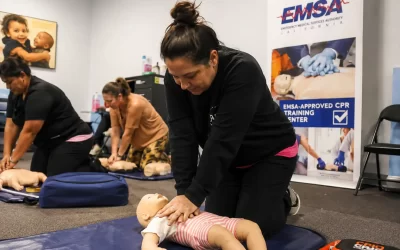
- Train employees hands-on in CPR & first aid (not just online).
- Use recognized courses (AHA, Red Cross, or equivalent).
- Maintain up-to-date certifications (renew per standard, often every 2 years).
- Provide and maintain adequate first-aid supplies, matched to your workplace’s risk levels.
- Document your training sessions, rosters, certificate renewals.
- Integrate multiple shifts or multiple locations under a coordinated training plan.
How A-B-Cpr Helps You Stay OSHA & Cal/OSHA Compliant
A-B-Cpr specializes in on-site CPR, First Aid, AED, and workplace safety training designed to align with both OSHA and California standards. When you partner with us:
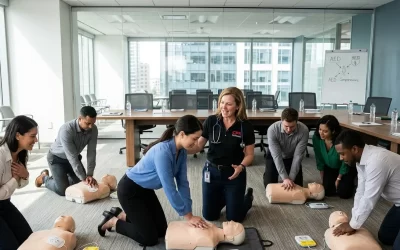
- We deliver hands-on, instructor-led training, not just theoretical or online modules
- We use AHA/Red Cross–approved curriculum
- We tailor training schedules to your site, shifts, and team size
- We provide guidance on kit setup and compliance under Title 8 §8351 and ANSI standards
- We train across Southern California — in San Diego County, Orange County, and adjacent cities
If you’re unsure whether your worksite requires CPR training or wants to audit compliance risk, request a training quote with us — we specialize in bridging regulation and real-world safety.
FAQ: OSHA CPR Requirements in California
| Question | Brief Answer |
|---|---|
| Is CPR mandatory under OSHA for all employers? | No. CPR is not universally required under general OSHA rules, but first-aid readiness is. If your site lacks immediate medical care, CPR may become necessary. Occupational Health & Safety+3OSHA+3OSHA+3 |
| What industries require CPR training? | Construction (1926.50), logging, confined spaces, electrical work, and other regulated sectors often require CPR training for designated workers. OSHA+2Occupational Health & Safety+2 |
| Do online-only courses count? | No. OSHA interprets that physical skills must be taught via hands-on practice, not purely online. OSHA |
| How fast must first aid reach a serious injury? | Under CA Section 8351, a first-aid provider must reach serious injuries within 5 minutes. CalDIR |
| What about first-aid kits? | Kits must match ANSI Z308.1 standards, be regularly inspected, and contain items reflective of workplace risk levels. First Aid 2000+2First Aid 2000+2 |
Want to make sure your business is fully compliant? Contact A-B-Cpr for an on-site training and compliance audit in Irvine, Costa Mesa, or elsewhere in Southern California.