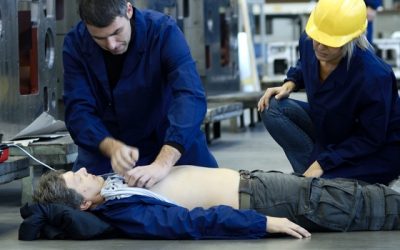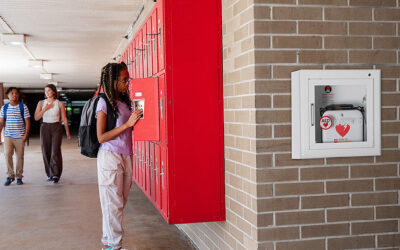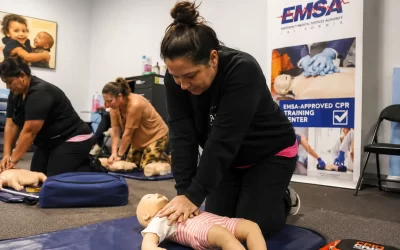
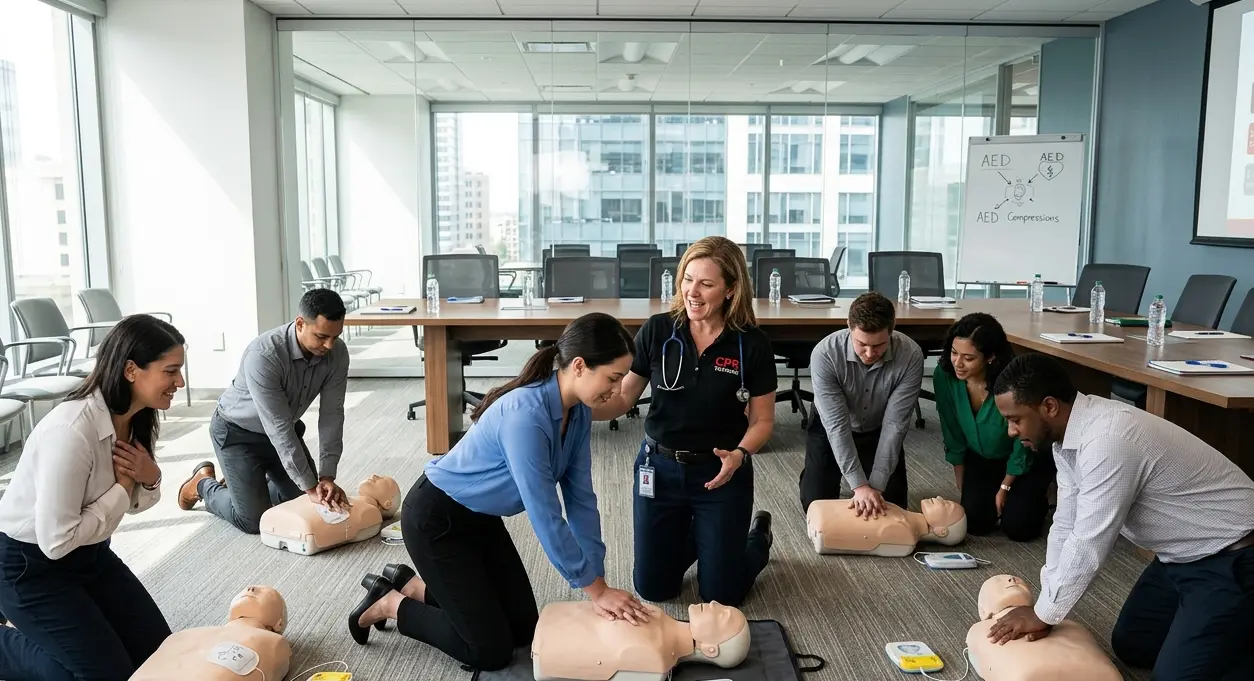
Organizing CPR training for your employees doesn’t have to mean sending everyone to separate classes or disrupting your entire workday.
With on-site CPR and First Aid training, an instructor comes directly to your business, school, or organization. Your team learns together, practices lifesaving skills, and completes the training appropriate for their responsibilities.
But successful workplace CPR training requires a little planning. You’ll need to choose the right course, determine how many employees need training, arrange a suitable space, and select a schedule that works for your organization.
This guide walks you through the process, from identifying your team’s training needs to organizing certifications and future renewals.
A-B-CPR has provided hands-on CPR and First Aid training throughout Southern California for over 25 years. Here’s how to organize a successful class at your workplace.
Step 1: Determine Which Employees Need CPR Training
Before scheduling a class, determine who should participate and why they need training.
Some organizations provide CPR training as part of employee safety and emergency preparedness. Others have specific certification requirements based on their industry, employee responsibilities, or licensing obligations.
Start by considering:
- Which employees are responsible for emergency response?
- Does your workplace have multiple shifts or locations?
- Are any employees required to maintain a specific CPR or First Aid certification?
- Do healthcare professionals need Basic Life Support (BLS)?
- Are employees working with children or infants?
- When do existing certification cards expire?
For employers with several locations or shifts, consider how training coverage will be maintained when certified employees are absent.
Important: OSHA and Cal/OSHA requirements vary by industry and workplace conditions. Not every California employee is automatically required to hold CPR certification.
For more information, read our guide to OSHA CPR requirements for California employers and our Cal/OSHA First Aid and CPR compliance checklist.
Step 2: Choose the Right CPR and First Aid Course
Different employees may need different kinds of training. Choosing the correct course before booking helps avoid unnecessary training or obtaining a certification that doesn’t meet the intended requirement.
Workplace CPR, AED and First Aid
For offices, construction companies, fitness facilities, schools, and many other businesses, CPR, AED, and First Aid training provides practical emergency response skills.
Training may include recognizing cardiac emergencies, performing adult and pediatric CPR, using an automated external defibrillator (AED), responding to choking, and providing First Aid for common injuries.
A-B-CPR offers its own established CPR and First Aid certification programs for general workplace training.
BLS for Healthcare Providers
Healthcare professionals, including nurses, EMTs, CNAs, and dental staff, may require Basic Life Support certification.
A-B-CPR is an American Heart Association (AHA) Training Site and offers official AHA BLS training for healthcare providers.
BLS training addresses lifesaving skills appropriate for healthcare environments, including high-quality CPR, AED use, and team-based resuscitation.
Childcare CPR and First Aid
Licensed childcare facilities have training needs that differ from those of a general office or workplace.
A-B-CPR offers EMSA-approved childcare CPR and First Aid training for applicable California childcare requirements, as well as blended pediatric training options.
Before booking, confirm which course format and certification your facility requires.
What About AHA vs. A-B-CPR Certification?
A-B-CPR offers both its own CPR and First Aid certifications and select official American Heart Association courses.
Both play an important role in the company’s training offerings. The correct option depends on the particular course and the requirements of the employer, licensing agency, or organization.
Rather than assuming every employee needs an AHA card, confirm the required credential before scheduling.
Step 3: Estimate Your Group Size
Once you’ve identified the appropriate training, determine how many employees will attend.
A-B-CPR typically schedules on-site classes for seven or more participants, although minimum group requirements can vary based on location, travel distance, scheduling, and course type.
There is no universal maximum group size. Larger organizations can arrange training based on their available space, equipment, instructor needs, and course requirements.
When planning your headcount, consider whether employees should be trained together or across multiple sessions.
For example, a business with two shifts might schedule separate sessions to maintain staffing during normal operations.
If you aren’t sure how to organize a large group, A-B-CPR can help determine a suitable training arrangement.
Step 4: Choose a Date and Schedule That Works
One advantage of hosting CPR training at your workplace is having more control over scheduling.
Instead of coordinating multiple employees’ travel and individual class bookings, you can arrange training around your organization’s operations.
Depending on instructor availability, options may include:
- Weekday sessions during normal business hours
- Early morning or evening training
- Weekend training
- Multiple sessions for different departments or shifts
- Recurring training arrangements for new employees and renewals
Consider which employees must remain available during the training and whether your organization can temporarily adjust staffing.
Planning tip: If several certification cards expire around the same time, scheduling employees together can simplify future renewals.
Contact A-B-CPR with your preferred dates so the team can confirm scheduling availability.
Step 5: Prepare Your Workplace for Hands-On Training
You don’t need a dedicated training facility to host a CPR class.
Many organizations use an existing conference room, break room, classroom, or other suitable open space.
The most important consideration is having enough room for participants to practice the required skills safely and comfortably.
What Space Do You Need?
Choose an area with:
- Enough open floor space for CPR manikins and hands-on practice
- Appropriate room for the number of participants
- Access that allows instructors to bring in training equipment
- Adequate lighting and a comfortable learning environment
- Minimal interruptions during instruction and skills practice
Depending on the course, tables and chairs may need to be moved to create space for practicing CPR.
A-B-CPR can help assess your training-space needs based on your group size and course selection.
What Equipment Does A-B-CPR Bring?
A-B-CPR instructors bring the training equipment needed for the selected class, including CPR manikins, AED trainers, and applicable First Aid training supplies.
Your organization provides the training area and coordinates employee attendance.
Step 6: Request a Group Training Quote
Once you know your approximate group size, location, course requirements, and preferred dates, you’re ready to request a quote.
A-B-CPR provides customized pricing for on-site CPR, AED, First Aid, and BLS training throughout Southern California.
Group training costs depend on factors such as:
- Number of participants
- Course or certification required
- Training location and travel requirements
- Scheduling arrangements
- Any additional sessions needed
There isn’t one fixed price that applies to every workplace.
To get an accurate quote, provide as much information as possible about your training needs.
Request an On-Site CPR and First Aid Training Quote
You can also call (619) 281-3304 to discuss your group.
Step 7: What Happens on Training Day?
On the scheduled training day, your A-B-CPR instructor arrives at your workplace with the necessary equipment.
The session follows the curriculum and hands-on skills requirements of the course selected.
Depending on the program, participants may practice:
- Adult, child, or infant CPR
- Recognizing cardiac arrest and activating emergency response
- Using an AED
- Responding to choking emergencies
- First Aid for injuries or medical emergencies
- Team-based response skills for healthcare BLS courses
Training is designed to help employees understand the skills and practice responding to realistic emergency situations.
The duration depends on the course, delivery format, and instructional requirements. Your training coordinator should confirm the expected class length before the scheduled date.
Step 8: Understand Certification and Keep Your Records Organized
After successfully completing the course, participants receive the certification associated with their training program.
For general workplace CPR and First Aid courses, this may be an A-B-CPR certification card. Applicable American Heart Association courses, such as BLS for Healthcare Providers, issue official AHA course completion cards.
A-B-CPR also provides EMSA-approved childcare training for applicable childcare requirements.
Certification delivery methods and processing times depend on the course selected.
Track Employee Certification Expiration Dates
For employers, maintaining organized training records is just as important as scheduling the initial class.
Consider tracking:
- Employee name and department
- Course completed
- Certification issuer
- Training completion date
- Card expiration date
- Anticipated renewal date
Many CPR certification cards are valid for two years, but always check the validity period and renewal requirements for the specific credential.
Keeping these records in one place makes it easier to identify employees who need renewal training and plan future group sessions.
Why Businesses Choose On-Site CPR Training
Hosting CPR training at your workplace offers several practical benefits.
Less Employee Travel and Scheduling Disruption
Employees can train at a familiar location without traveling individually to an off-site classroom.
This can reduce coordination time and make scheduling easier for businesses with multiple employees.
Hands-On Training for Your Team
Employees learn and practice lifesaving skills in the same session, helping build a shared understanding of emergency response procedures.
Training Appropriate to Your Organization
Different workplaces face different emergency situations. A healthcare facility, construction site, and childcare center may have different training needs.
Choosing the correct course helps your employees receive instruction relevant to their responsibilities.
Simpler Certification Management
Training employees together may make it easier to track course completion, maintain records, and plan future renewals.
Potential Cost Efficiencies
Group training can offer cost and scheduling efficiencies compared with registering employees individually.
Actual pricing depends on group size, course requirements, and location, so requesting a customized quote is the best way to compare options.
Where Does A-B-CPR Offer Workplace Training?
A-B-CPR provides on-site CPR and First Aid training throughout Southern California, including:
- San Diego County
- Orange County
- Riverside County
- San Bernardino County
- Los Angeles County
From offices and healthcare facilities to schools, gyms, construction companies, and childcare centers, A-B-CPR helps organizations coordinate hands-on employee training.
Travel arrangements, group requirements, and available dates vary by location.
Businesses that prefer individual classroom training can also explore A-B-CPR’s San Diego and Oceanside class locations.
Frequently Asked Questions About Hosting Workplace CPR Training
How many employees are needed for on-site CPR training?
A-B-CPR typically schedules group training for seven or more participants. Minimum requirements may vary based on the course, location, travel distance, and scheduling. Larger groups can also be accommodated with appropriate arrangements.
How long does a workplace CPR training class take?
Class duration depends on whether employees are taking CPR/AED, CPR and First Aid, BLS, or a childcare course. The training format and course requirements also affect the length. A-B-CPR will confirm the expected duration before scheduling.
Do employees receive an American Heart Association certification card?
Employees receive the certification associated with the course they complete. A-B-CPR offers official AHA courses, including BLS for Healthcare Providers, alongside its own CPR and First Aid certification programs and EMSA-approved childcare training.
Not every A-B-CPR course issues an AHA card, so employers should confirm their certification requirements before booking.
Can we schedule CPR training outside normal business hours?
Flexible scheduling may be available, including early morning, evening, or weekend sessions. Options depend on instructor availability, location, and group size.
Does the business need to supply CPR equipment?
No. A-B-CPR brings the training equipment needed for the selected course. Your organization provides a suitable space for instruction and hands-on practice.
Can employees with different certification needs train on the same day?
A-B-CPR can help coordinate training for teams with different requirements, such as general workplace CPR, First Aid, and healthcare BLS. Separate courses or sessions may be necessary depending on the certifications required.
Ready to Host CPR Training at Your Workplace?
Planning workplace CPR training is easier when you have an experienced training provider helping with course selection, scheduling, equipment, and certification.
With over 25 years of experience, A-B-CPR provides professional, hands-on CPR, AED, First Aid, and BLS training for businesses and organizations across Southern California.
Whether you’re training a small team or coordinating multiple departments, we’ll help you organize the appropriate course for your employees.
Request a Group CPR Training Quote
Or call (619) 281-3304 to discuss your workplace training needs.