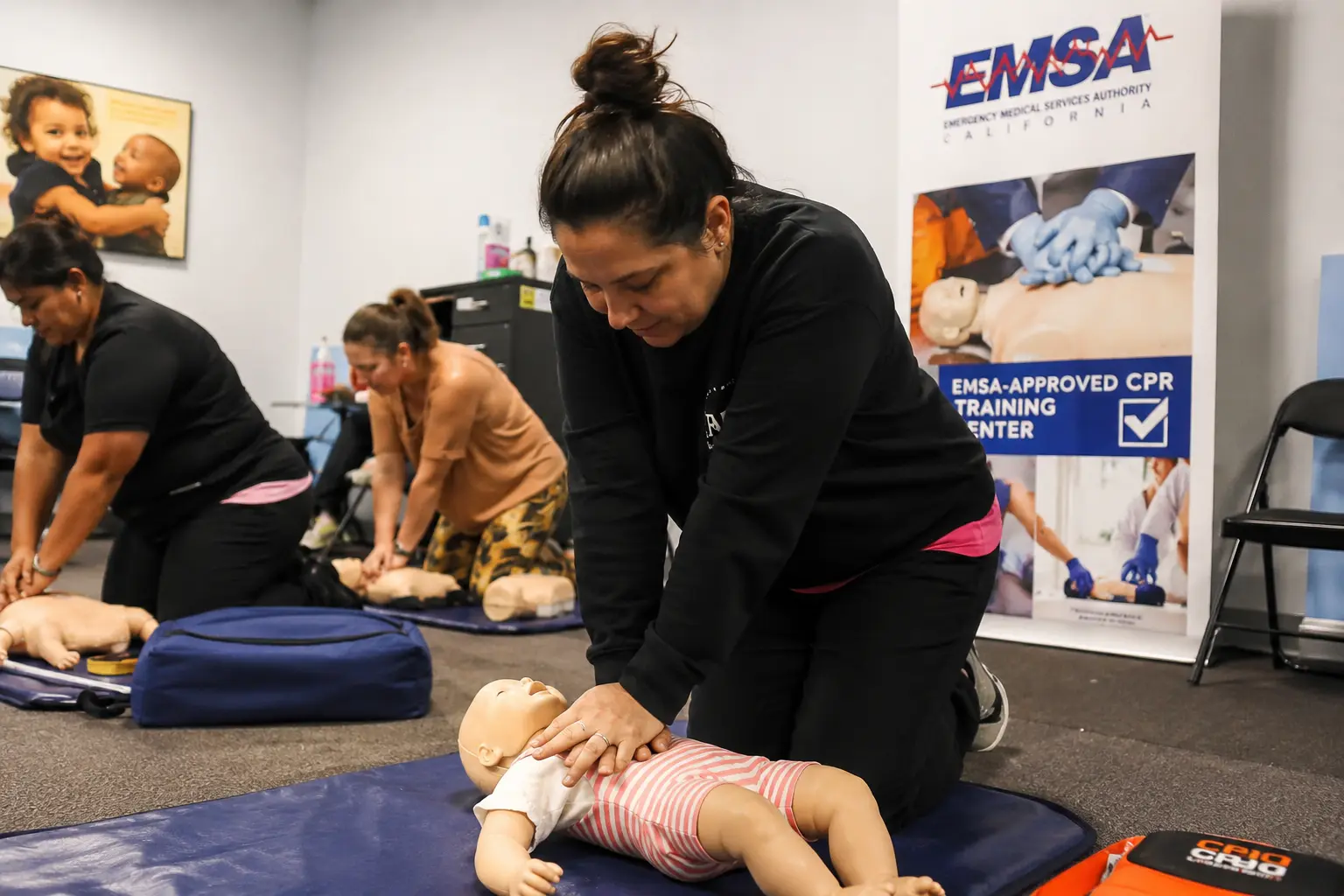
If you run or work in a licensed childcare facility in California, you have to hold specific safety training. That part is simple. What trips almost everyone up is that the state actually requires two different EMSA trainings, not one, and they renew on completely different schedules. Providers routinely take the wrong class, take only half of what they need, or pay for an “online certification” that their licensing analyst won’t accept.
We have certified childcare providers across San Diego County for more than 25 years, and these are the same questions we answer on the phone every week. This guide lays out exactly what California requires, which class covers which requirement, what your Community Care Licensing analyst will actually accept, and how to avoid paying twice. If you would rather just talk it through, call us at (619) 281-3304.
The short version: California requires two separate EMSA trainings
Under California Health & Safety Code Section 1596.866 and Title 22, every person who provides care in a licensed family child care home or child care center has to complete EMSA-approved training in two areas:
- Pediatric CPR and Pediatric First Aid. Hands-on certification covering CPR and first aid for adults, children, and infants, plus AED use. This one expires and must be renewed, typically every two years.
- Preventive Health and Safety Practices (often called “PHC” or “Preventive Health”). An 8-hour course covering infectious disease, sanitation, immunizations, injury prevention, nutrition, and lead poisoning prevention. This one is generally a one-time requirement that does not expire.
They are different courses, taught from different EMSA-approved curricula, and a certificate for one does not satisfy the other. The most common mistake we see is a provider who completed CPR and First Aid years ago and assumes they are fully compliant, when they have never taken Preventive Health at all (or the reverse).
The two requirements, side by side
| Pediatric CPR & First Aid | Preventive Health & Safety (PHC) | |
|---|---|---|
| What it covers | Adult/child/infant CPR, AED use, pediatric first aid (choking, allergic reactions, burns, bleeding, injuries) | Infectious disease and sanitation, immunizations, safety and emergency procedures, nutrition (1 hr), lead poisoning prevention |
| Length | 8 hours in person, or a 3-hour online + 3-hour in-person hybrid | 8 hours (a 7-hour preventive health component plus a 1-hour nutrition component) |
| Renews? | Yes. Renew before it expires (generally every 2 years) | No. Generally a one-time requirement |
| Hands-on skills required? | Yes. CPR and first aid must include an in-person skills check | No. Can be completed as a live webinar |
| A-B-CPR format | In-person ($70) or AHA Heartsaver hybrid ($79) | Live webinar in English or Spanish ($79) |
A new childcare hire usually needs both before or shortly after they start working with children. An experienced provider keeping their license current usually just needs to renew the CPR and First Aid piece, because Preventive Health is already behind them for good.
The card that confuses everyone: EMSA stickers vs. AHA Heartsaver cards
Here is the single most misunderstood point in childcare compliance, and it is worth getting right because it determines whether your licensing analyst accepts your card.
Some EMSA-approved courses issue a course-completion card with an EMSA sticker on it. That sticker is what tells Community Care Licensing the training met EMSA’s standard. But there is a second, fully accepted path: the American Heart Association Heartsaver Pediatric First Aid CPR/AED card. AHA Heartsaver pediatric cards are accepted by Community Care Licensing without an EMSA sticker, because the AHA is its own nationally recognized authority. So if you take our AHA hybrid childcare class and receive an AHA Heartsaver card, you do not need (and will not get) an EMSA sticker, and you are still fully compliant.
Both paths are valid. The right one depends on which format fits your schedule, which we break down next. If anyone tells you an AHA Heartsaver pediatric card “isn’t good enough” for childcare licensing, that is incorrect. You can confirm it yourself on EMSA’s childcare provider page.
Choosing your Pediatric CPR & First Aid format
We offer two ways to satisfy the CPR and First Aid requirement, and the difference is format and card type, not whether one “counts more” than the other.
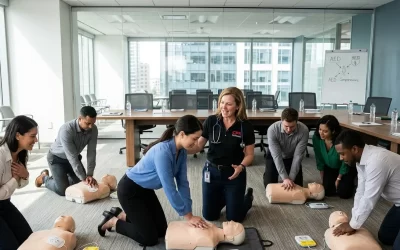
In-person EMSA-approved class ($70). A single 8-hour day, fully in person, covering CPR for adults, children, and infants, AED use, and pediatric first aid. This is the right pick if you learn best hands-on in a classroom, and it is the only format eligible for the YMCA Childcare Provider Grant, which can cover the cost of certification for providers who qualify. We can point you to the grant application when you register.
AHA Heartsaver hybrid class ($79). A 3-hour self-paced online portion followed by a 3-hour in-person skills session. You complete the knowledge portion on your own schedule, then come in for the hands-on check. You receive the AHA Heartsaver Pediatric First Aid CPR/AED card described above. This is the right pick if you need flexibility but still want real, in-person skills practice. The hybrid is not eligible for the YMCA grant.
Both are taught at our Mission Valley and Oceanside classrooms. A fully online, no-skills-session “certification” cannot satisfy the CPR and First Aid requirement in California, because the hands-on skills check is mandatory. If a course never has you demonstrate compressions in front of an instructor, it will not hold up with your licensing analyst.
What the Preventive Health & Safety webinar actually covers
The Preventive Health requirement is the one most often forgotten, partly because it sounds vague. It is not a CPR class. It is an 8-hour course (a 7-hour preventive health component plus the 1-hour nutrition component EMSA has required since 2016) covering the day-to-day health and safety knowledge a childcare operator needs:
- Immunization requirements and how to manage health records for compliance
- Infectious disease and sanitation, including how illness spreads in a childcare setting and how to prevent it
- Safety policies and emergency procedures for injury prevention and emergency response
- Nutrition guidelines, including food safety and meal planning for children
- Lead poisoning prevention, using the official California Department of Public Health (CDPH) curriculum required for EMSA-approved preventive health training since July 2020
We deliver this as a live webinar in both English and Spanish for $79, so you can complete it from home or your facility, anywhere in California. It can be taken as one 8-hour session or split into two 4-hour midweek sessions. Because it is generally a one-time requirement, most providers take it once when they enter the field and never have to repeat it.
Who needs this training (and who does not)
This training is for people working directly in licensed childcare:
- Daycare providers who will be one-on-one with children
- Daycare owners and directors
- Staff in licensed family child care homes and child care centers
It is not the right training for EMTs, RNs, CNAs, or LVNs (they need BLS for Healthcare Providers instead), and it is not aimed at school teachers, personal trainers, or coaches, who are usually covered by a standard CPR and First Aid class. Taking the wrong class is the most expensive mistake here, because you end up paying for a second one. If you are not sure which bucket you fall into, call us before you book.
How to make sure your training will actually be accepted
EMSA approval is what separates valid childcare training from a certificate your licensing analyst will reject. Before you pay anyone, confirm three things:
- The provider is an EMSA-approved training program (or issues AHA Heartsaver pediatric cards). You can look up requirements and verification on EMSA’s childcare provider page.
- The CPR and First Aid course includes an in-person skills check. Online-only does not satisfy the requirement.
- You are taking the right course for your gap. New providers usually need both trainings. Renewing providers usually need only the CPR and First Aid piece.
A-B-CPR is an EMSA-approved provider and an American Heart Association Training Center. Our childcare CPR and First Aid classes issue cards accepted by Community Care Licensing, and our Preventive Health webinar uses the current CDPH lead poisoning prevention curriculum.
Why San Diego childcare providers train with A-B-CPR
We are a family-owned San Diego training center, and we have been teaching CPR and First Aid here since 1998 (the company itself dates to 1993). Owner Mike Long started as an EMT and AHA CPR Instructor, became an AHA BLS Instructor Trainer, and has held AHA BLS Training Center Faculty status for the Western Region since 2021. He built A-B-CPR’s own state-approved Health & Safety program, and the company has grown from fewer than 1,000 students a year to more than 15,000.
For childcare providers specifically, that means a few practical things: we know exactly which card your licensing analyst accepts, we offer the Preventive Health course in Spanish as well as English, we have classrooms in both Mission Valley and Oceanside, and we can help you find grant funding for the in-person class. And if you call, a real person who knows childcare licensing picks up the phone.
Frequently asked questions
Do California childcare providers need CPR and First Aid certification? Yes. Under California Health & Safety Code Section 1596.866 and Title 22, staff in licensed family child care homes and child care centers must hold EMSA-approved pediatric CPR and first aid training. It is a condition of licensing, not optional.
What are the two EMSA trainings California childcare providers need? Pediatric CPR and First Aid (hands-on, renewed roughly every two years) and Preventive Health and Safety Practices (an 8-hour course, generally a one-time requirement). They are separate courses and one does not substitute for the other.
How often do I have to renew my childcare CPR and First Aid certification? The pediatric CPR and First Aid certification expires and must be renewed, generally every two years. The Preventive Health and Safety course is generally a one-time requirement that does not expire.
Does my AHA Heartsaver Pediatric card need an EMSA sticker for childcare licensing? No. American Heart Association Heartsaver Pediatric First Aid CPR/AED cards are accepted by Community Care Licensing without an EMSA sticker, because the AHA is its own recognized certifying authority.
Can I complete childcare CPR and First Aid certification fully online? No. The CPR and First Aid requirement includes a mandatory in-person skills check, so a fully online, no-skills course cannot satisfy it. The Preventive Health and Safety course, by contrast, can be completed as a live webinar.
Is the Preventive Health and Safety training available in Spanish? Yes. A-B-CPR delivers the EMSA-approved 8-hour Preventive Health and Safety webinar in both English and Spanish.
Is there financial help to pay for childcare provider certification? Yes. The YMCA Childcare Provider Grant can cover the cost of certification for providers who qualify. At A-B-CPR, the grant applies to the in-person EMSA pediatric CPR and First Aid class. We can share the application when you register.
What is the difference between the $70 in-person class and the $79 AHA hybrid class? The $70 class is a single 8-hour in-person session and is eligible for the YMCA grant. The $79 hybrid is a 3-hour online portion plus a 3-hour in-person skills session and issues an AHA Heartsaver Pediatric card. Both satisfy the CPR and First Aid requirement.
I am a nurse or EMT who also works in childcare. Do I need this class? The childcare class is built for daycare providers and owners. Healthcare professionals such as EMTs, RNs, CNAs, and LVNs need BLS for Healthcare Providers instead. If your role spans both, call us at (619) 281-3304 and we will sort out exactly what you need.
Ready to get compliant?
If you are a new provider, you most likely need both the Pediatric CPR & First Aid class and the Preventive Health & Safety webinar. If you are renewing, you most likely just need the CPR and First Aid class. Book online, or call (619) 281-3304 and we will make sure you sign up for exactly what your license requires, no more and no less.