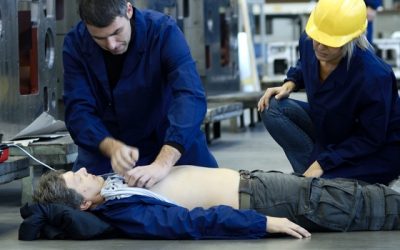
Starting January 1, 2027, every California youth sports organization needs a written cardiac emergency response plan. It doesn’t have to be long. It has to be clear enough that a volunteer coach knows exactly what to do in the first few minutes, and it has to cover four things the law lists.
Here’s what to include, a simple outline to start from, and a sample parent email you can adapt.
Not legal advice. The law says your plan must be consistent with nationally recognized, evidence-based standards. Use this as a starting point, and have your board (and a medical advisor, if you have one) review your final plan. Your governing body may have its own template or rules.
For the full set of 2027–2028 requirements, see California youth sports CPR & AED requirements.
What California requires in the plan
Under Health & Safety Code §124238.5(b), the plan must detail:
- The location of any AEDs, and the procedures to follow in a sudden cardiac arrest
- The responsibilities of the coach, administration and athletes during the event
- How coaches, administration and athletes will be notified about the plan and trained on it
- A yearly electronic message to parents or guardians with the plan (or a link), the AED locations, and the staff members to notify in a sudden cardiac event
The plan must also be reviewed with coaches and staff every year.
Step 1: Map the AEDs at every location
List every field, gym and pool your league uses. For each one, write down:
- Whether the facility has an AED, and exactly where it is (for example, “outside wall of the snack bar, by the first-base side”)
- Whether it’s reachable during your practice and game times (locked buildings don’t count)
- Who brings the league’s AED to locations that don’t have one
Starting January 1, 2028, AED access is required at every official practice and game. See our youth sports AED guide.
Step 2: Write the response steps
Keep this to one page that coaches can keep in their bag. A basic sequence:
- Recognize it. A person collapses and is unresponsive and not breathing normally, or is only gasping. Treat a collapse that isn’t clearly caused by contact as a possible cardiac arrest.
- Call 911. Put the phone on speaker.
- Start CPR. Push hard and fast in the center of the chest.
- Get the AED. Send a specific person by name to get it. Turn it on and follow the voice prompts. For a refresher on device steps, see how to use an AED.
- Keep going until EMS takes over.
- Meet EMS. Send someone to the parking lot or gate to guide responders in.
These steps match what California already requires in the sudden cardiac arrest information sheet: call 911, perform hands-only CPR, and use an AED if one is available (§124235).
Step 3: Assign roles
The law asks you to spell out what coaches, administrators and athletes do. For example:
| Role | Responsibility |
|---|---|
| Head coach | Starts CPR or directs another trained adult to |
| Assistant coach | Calls 911 and stays on the line |
| Designated runner (coach, team parent or older athlete) | Gets the AED |
| Field or board contact | Meets EMS, then notifies the athlete’s parent or guardian |
| Athletes | Move away from the area, stay with a coach, and point responders to the scene if asked |
Name a backup for each role, since not every coach is at every practice.
Step 4: Plan how people learn the plan
Write down how each group gets trained and notified. For example:
- Coaches: CPR/AED certification (renewed at least every two years), plus a plan walk-through at the preseason coaches’ meeting
- Board and field staff: the same walk-through, plus an AED location check at each field
- Athletes: a short, age-appropriate talk at the first practice (“If someone collapses, get a coach and move back”)
Need to certify coaches? See how to get every coach certified before the season.
Step 5: Send the yearly parent email
The law requires a yearly electronic message to parents or guardians. It must include the plan (or a link to it), where the AEDs are, and the staff members to notify in a sudden cardiac event.
Sample parent email (adapt it to your league):
Subject: [League name] cardiac emergency plan for the [year] season
Hi families,
As part of California’s youth sports safety law, here is our league’s cardiac emergency response plan for this season: [link to plan].
Where our AEDs are:
– [Field 1]: [exact location]
– [Field 2]: [exact location]
Who to notify in a cardiac emergency: After calling 911, notify [Name, role, phone] or [Name, role, phone].
All of our coaches are trained in CPR and AED use, and we review this plan with coaches and staff every year. Questions? Reply to this email.
Thank you,
[Name], [Role], [League name]
The bracketed fields in the sample email are for the league to fill in.
Step 6: Review it every year
Put the yearly review on your board calendar, ideally right before the season starts. Each year, check:
- Are AED locations still correct, and are pads and batteries current?
- Are the names and phone numbers current?
- Are all coaches certified, with no certifications expiring mid-season?
- Did you send this year’s parent email?
A one-page plan outline you can copy
- League name, season and date reviewed
- Locations and AEDs (table: field or gym, AED location, who brings an AED if none)
- Emergency steps (the six steps above)
- Roles and backups (table)
- Training and notice (coaches, staff, athletes)
- Parent notice (date sent and link)
- Contacts (designated staff, names and phones)
- Review log (date, reviewed by)
Get the free 2027 checklist
The emergency plan, the parent notice, coach certification and AED access on two printable pages.
Download the free checklist →
Want your coaches to practice the plan hands-on? → On-site CPR & AED sessions for teams
FAQ
Does our cardiac emergency response plan need to be written?
Yes. Starting January 1, 2027, California requires youth sports organizations to have a written plan.
How often do we review it?
At least once a year with coaches and staff.
Do we have to send it to parents?
Yes. The law requires a yearly electronic message to parents or guardians with the plan or a link to it, AED locations, and the staff members to notify.
What if a field doesn’t have an AED?
Starting January 1, 2028, your league must make sure an operational AED is available for the whole practice or game if the facility doesn’t provide one.
Sources
Official sources for the requirements summarized on this page: