
Not every California business is required to buy an AED. But the moment you acquire one, the law gives you a list of ongoing duties.
Here is what California actually requires, in plain English. Why trust us? We have sold, rented, and serviced AEDs across San Diego County since 1998.
Who is legally required to have an AED in California?
There is no single law that covers every business. Requirements come from different places depending on what you do.
Health studios and gyms: yes, required. Under Health & Safety Code §104113, every health studio must acquire, maintain, and train staff in the use of an AED. This is a hard requirement, not a recommendation. See our full guide to AED requirements for gyms and health studios.
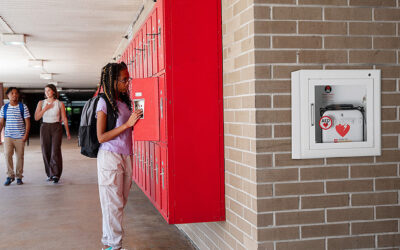
Building owners: not required, but with duties if you have one. §1797.196 is explicit that nothing in it requires a building owner or manager to install an AED. If you do have one, the section adds obligations covered below.
Schools, public buildings, and specific occupancies. Several California statutes and local ordinances place AED requirements on particular facility types. These change, and they vary by jurisdiction. Check with your local EMS agency or your building department for your specific occupancy.
Everyone else: not required, but strongly advised. Cal/OSHA does not mandate AEDs for general workplaces. Survival from cardiac arrest falls sharply with every minute that passes before defibrillation, which is why most safety programs treat an AED as standard even where no law compels one.
What the law requires once you own an AED
This is the part that can catch a lot of business owners out. Under §1797.196, whoever acquires an AED must:
Test it at least twice a year, and after every use. Not just when it beeps. A schedule, documented.
Inspect it at least every 90 days. A check for any issue affecting operability. Health studios face a stricter standard — see below.
Notify your local EMS agency. Tell an agent of the local EMS agency the AED exists, where it is, and what type it is. If you move it, tell them again.
Keep the records. Documentation of all maintenance and testing. If you cannot produce it, you effectively did not do it.
Follow placement regulations. Comply with all regulations governing where an AED may be placed.
If you own a building, there is an additional requirement
Building owners must annually notify tenants of AED locations, offer a demonstration of proper use, and post instructions in at least 14-point type.
Health studios: every 30 days, not 90
§104113 requires health studios to check readiness after each use and at least once every 30 days when unused, and to keep records of those checks. That is three times more often than the general standard.
The part most owners miss
Immunity from liability is conditional on compliance.
For health studios, §104113 extends liability protection to employees, owners, board members, and managers, but only where the facility has fully complied with the section’s duties. Skip the 30-day checks, and you may forfeit the protection the statute was written to give you.
An AED sitting on a wall with expired pads is not just useless in an emergency. It can be worse than not having one.
What this looks like in practice
| Duty | Frequency | Who usually forgets |
|---|---|---|
| Operability inspection | Every 90 days (30 for health studios) | Almost everyone |
| Testing | Twice yearly, plus after each use | Most |
| Pad replacement | Per manufacturer, typically every 2–4 years | Very common |
| Battery replacement | Per manufacturer, typically every 2–4 years | Very common |
| EMS notification | At acquisition, and after any move | Most |
| Records | Ongoing | Most |
Pads and batteries expire on a date printed on the unit. They do not announce themselves. See our guide to AED pad and battery replacement.
How to stay compliant without thinking about it
You have three options.
Do it yourself. Set calendar reminders, keep a binder, track expiry dates, and file the EMS notification. Workable if someone owns it.
Buy with a managed program. Our AED packages include EMS registration, maintenance tracking, and expiry alerts, so the schedule is handled for you.
Rent. With an AED rental, the compliance work stays with us. Inspections, testing, pads, batteries, and registration are all included.
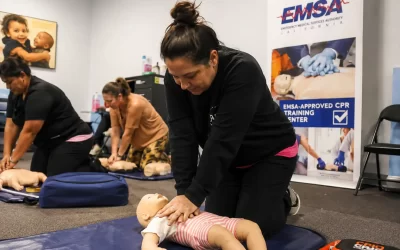
Whichever you choose, staff need to know how to use it. Our Combination CPR/AED and First Aid class covers AED use, or we can bring training to your workplace.
Get a straight answer for your situation
Tell us what kind of facility you run and we will tell you what applies. No obligation.
Call (619) 281-3304 or request a quote.
AHA and EMSA accredited. Family-owned in San Diego since 1998. 666 five-star reviews. Two locations.
FAQ (also used for FAQPage schema)
Is my business required to have an AED in California? It depends on your facility type. Health studios are required under Health & Safety Code §104113. Building owners are not required by §1797.196, though other statutes and local ordinances cover specific occupancies. Most general workplaces are not required but are strongly advised.
How often must an AED be inspected in California? At least every 90 days for operability under §1797.196, and tested at least twice a year plus after each use. Health studios must check readiness at least every 30 days when the unit is unused, and after each use.
Do I have to register my AED with anyone? Yes. §1797.196 requires you to notify an agent of your local EMS agency of the AED’s existence, location, and type. Notify them again if you move it.
What happens if I do not maintain my AED? Beyond the risk of the device failing when needed, liability immunity can be conditional on compliance. For health studios, §104113 ties protection for employees, owners and managers to the facility having met its duties.
Do employees need training to use an AED? Health studios must train staff, one trained employee per AED for the first five units, and one more for each additional five, available during operating hours. Elsewhere, training is not always mandated but is standard practice.
Does renting an AED cover the compliance requirements? It can. Our rentals include inspections, testing, pad and battery replacement, and EMS registration, so the duties are performed and documented on your behalf.