Understanding OSHA regulations is one thing.
Actually staying compliant at your workplace is another.
If you operate a business in California, first aid readiness requirements fall under Cal/OSHA Title 8 regulations, primarily:
- §3400 – Medical Services and First Aid (General Industry)
- §1512 – Emergency Medical Services (Construction)
This guide breaks down how to implement those requirements in practical terms — without overcomplicating your training program.
If you’re looking for a full legal breakdown of when CPR is specifically required, see our guide on
👉 OSHA CPR requirements for California employers.
Below, we focus on implementation.
Step 1: Identify Which Regulation Applies to You
Most California employers fall under:
Title 8 §3400 (General Industry)
This regulation requires employers to ensure:
- Medical services are readily available
- Employees are trained in first aid when medical facilities are not “in near proximity”
- Adequate first aid supplies are provided
Title 8 §1512 (Construction)
Construction employers must ensure:
- Emergency medical services are available
- A person trained in first aid is available at job sites when needed
Neither section universally mandates CPR for every workplace — but in many environments, CPR training becomes part of demonstrating adequate first-aid readiness.
Step 2: Evaluate Your Worksite’s Risk Level
Cal/OSHA expects first aid readiness to match workplace hazards.
Higher-risk industries commonly require structured training coverage:
- Construction & trades
- Warehousing & manufacturing
- Electrical work
- Confined spaces
- Childcare & schools
Lower-risk environments (offices, retail, service businesses) may still require trained personnel if emergency services are not immediately accessible.
When in doubt, providing CPR & First Aid training reduces compliance risk and liability exposure.
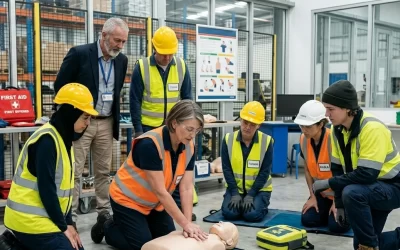
Step 3: Ensure Trained Personnel Are Available
Under §3400 and §1512, employers must ensure trained individuals are available when medical facilities are not in near proximity.
Best practice in California workplaces:
- At least one trained employee per shift
- Additional coverage for larger facilities
- Backup personnel for multiple buildings or job sites
- Coverage during breaks, evenings, and off-hours
If you need to train multiple employees efficiently,
👉 Host an on-site CPR & First Aid class at your workplace
Regional options:
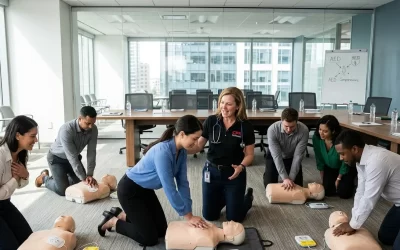
Step 4: Provide Hands-On, Recognized Training
OSHA interpretations consistently emphasize that first aid and CPR training must result in competent responders.
That typically means:
✔ Skills practice
✔ Hands-on evaluation
✔ Recognized curriculum (AHA or Red Cross standards)
✔ Current certifications (often valid for 2 years)
Online-only CPR training may not meet requirements where hands-on skills are necessary.
For classroom or hybrid certification, see:
👉 CPR & First Aid training in San Diego
Step 5: Maintain Adequate First Aid Supplies
Training alone is not sufficient.
Title 8 §3400 requires that:
- First aid supplies be readily available
- Supplies be adequate for workplace hazards
ANSI Z308.1 standards are commonly used as a guideline for determining appropriate kit contents.
Employers should:
- Inspect kits regularly
- Replace expired or used supplies
- Document inspection dates
Maintaining inspection logs strengthens your compliance position.
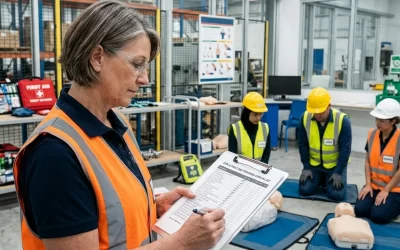
Step 6: Keep Documentation Organized
During a Cal/OSHA inspection, employers may need to provide:
- Training rosters
- Copies of certifications
- Expiration dates
- Instructor credentials
- First aid supply inspection records
A simple compliance system (spreadsheet or safety binder) can prevent lapses.
Renew certifications before they expire — most CPR certifications are valid for two years, depending on the issuing organization.
Step 7: Develop a Basic Emergency Response Plan
Even when not explicitly required in writing, having a documented plan reduces risk.
Your workplace emergency plan should identify:
- Who responds to medical incidents
- Where kits and AEDs are located
- How emergency services are contacted
- Post-incident documentation procedures
If your workplace maintains an AED, ensure employees are trained in its proper use.
You can learn more about AED options here:
👉 Workplace AED defibrillators
Common Compliance Gaps Employers Overlook
❌ Only training one person in a large facility
❌ Allowing certifications to lapse
❌ Relying solely on online training where hands-on skills are required
❌ Failing to inspect and document first aid supplies
❌ Not accounting for multi-shift coverage
Most compliance issues arise from documentation or coverage gaps — not from a lack of good intentions.
Quick Compliance Summary
Here’s a simplified checklist for California employers:
✔ Identify whether §3400 or §1512 applies
✔ Evaluate workplace hazards
✔ Ensure trained personnel are available
✔ Provide hands-on, recognized CPR & First Aid training
✔ Maintain adequate first aid supplies
✔ Keep certification & inspection records
✔ Renew training every two years
Following these steps will help most California businesses meet Cal/OSHA first aid readiness expectations.
Need Help Getting Your Team Compliant?
A-B-CPR provides OSHA-aligned, instructor-led CPR, First Aid, and AED training across Southern California.
We bring certified instructors directly to your workplace and help you:
- Train multiple employees efficiently
- Maintain documentation
- Align with California safety standards
- Reduce compliance risk
👉 Request on-site CPR & First Aid training for your team
If you’re unsure what your worksite requires, we’re happy to help you evaluate your training needs.