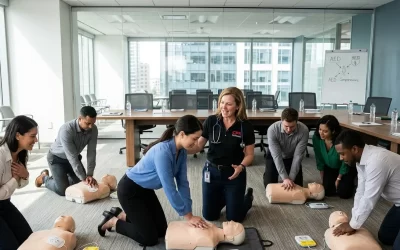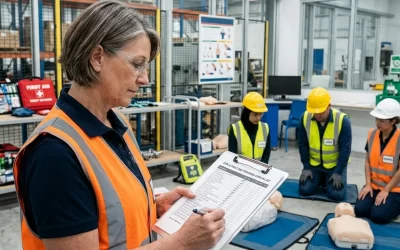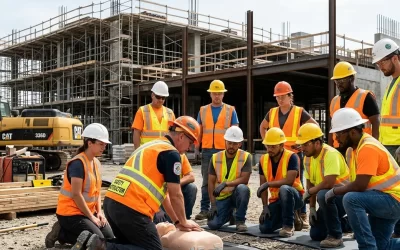
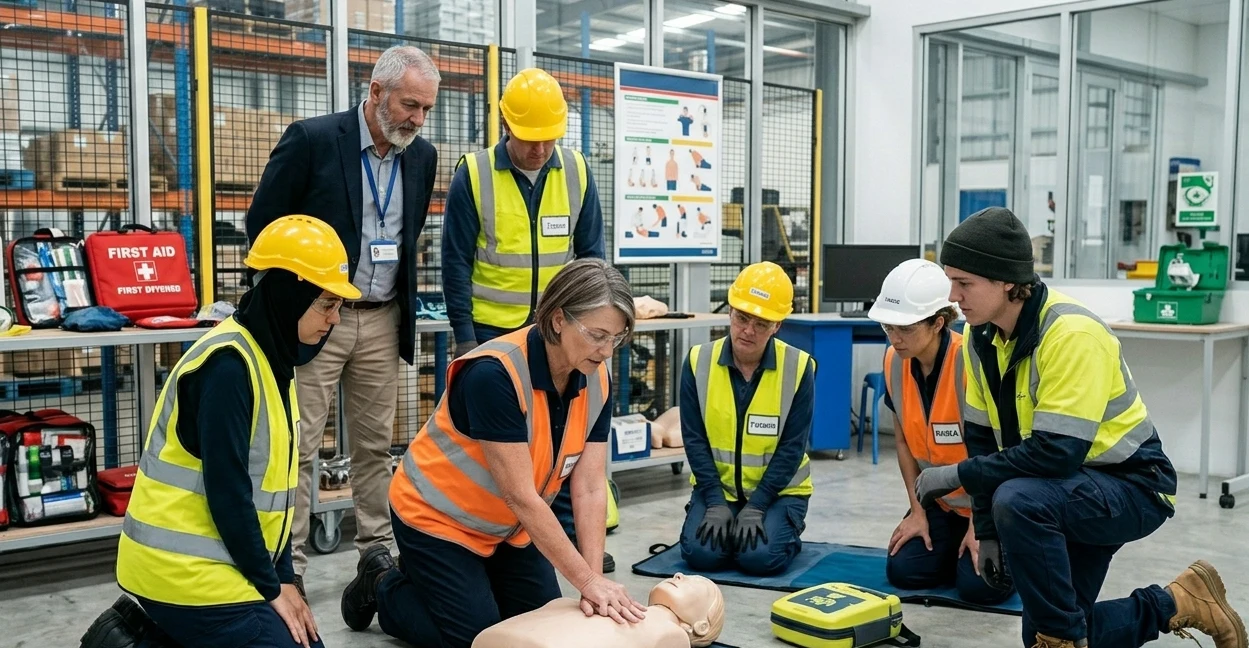
OSHA does not give you a specific number. There is no regulation that says “one trained employee per 25 workers” or any fixed ratio. What OSHA does require is that trained first aid personnel be available during all working hours when the workplace is not within close proximity to a medical facility. The real question is not “how many does OSHA require?” but “how many do I actually need to maintain reliable coverage?” A-B-CPR in San Diego helps California businesses figure out the right answer for their specific operation.
For the full breakdown of OSHA and Cal/OSHA regulations, see our guide to OSHA CPR requirements for California employers.
What OSHA Actually Says
Under 29 CFR 1910.151 (general industry) and 29 CFR 1926.50 (construction), the requirement is straightforward: when emergency medical services are not nearby, at least one person with a valid first aid certificate must be present at the worksite.
“At least one” is the floor, not the target. OSHA’s letters of interpretation have clarified that employers must ensure coverage is continuous. If your one trained person goes to lunch, leaves early, or is working in a different part of the building, you are out of compliance.
How to Calculate the Right Number for Your Business
The answer depends on several factors specific to your operation:
Shift Coverage
Every active shift needs its own trained personnel. If you run two shifts, you need trained people on both. If you run weekends, those shifts need coverage too.
Example: A San Diego manufacturing facility runs three shifts, 7 days a week. That is 21 separate shift slots per week. Training just 2 people total would leave most shifts uncovered. This facility needs a minimum of 2 trained employees per shift, which means at least 6 to 8 trained people to account for days off and schedule rotations.
Multi-Location Considerations
Each physical location where employees work must have its own trained personnel. A company with a main office and a warehouse cannot count the office-trained employee as coverage for the warehouse.
For businesses across San Diego County with multiple sites, A-B-CPR recommends training at least 2 people per location per shift.
Absence Buffer
People get sick, take vacation, and change jobs. If you train the bare minimum, a single absence creates a compliance gap. Build in a buffer.
A-B-CPR’s recommendation for California businesses: Train 10 to 15 percent of your total workforce in CPR and first aid. This typically provides enough coverage across shifts, locations, and normal absence rates without over-investing in training.
For a 50-person company, that means 5 to 8 certified employees. For a 100-person company, 10 to 15.
Jobsite Risk Factors
Higher-risk workplaces need more trained people, not fewer. Consider:
- Physical labor environments (construction, warehousing, manufacturing) where injuries happen more frequently.
- Work with heavy equipment or machinery where the severity of potential injuries is higher.
- Outdoor work in California heat where heat illness is a constant risk during warm months.
- Remote locations where ambulance response times are longer. In rural parts of San Diego County and surrounding areas, having multiple trained responders is not optional.
The higher the risk, the shorter the acceptable gap between an incident and a trained response. Plan accordingly.
What “Trained Personnel” Means in Practice
OSHA expects more than just a card in someone’s wallet. Trained personnel must be:
- Currently certified. Cards expire after two years. Expired certification means zero coverage from that person.
- Physically present. Someone certified who works at a different location or is traveling does not count.
- Capable of responding. Training should include hands-on practice, not just online video watching. Cal/OSHA expects practical skills competency.
- Known to other employees. Coworkers should know who on their shift is trained and how to reach them in an emergency.
A Practical Approach to Getting It Right
Here is how most businesses A-B-CPR works with in San Diego handle it:
- Count your shifts, locations, and average daily headcount.
- Identify 2 trained people minimum per shift per location.
- Add a buffer for absences (usually 1 to 2 additional people per location).
- Schedule group training to certify everyone at once. This is faster and more cost-effective than sending individuals.
- Track certification dates and schedule recertification 60 to 90 days before expiration.
Use our Cal/OSHA compliance checklist to make sure your training plan covers all the other requirements too.
Ready to train your team? A-B-CPR in San Diego offers on-site group training for businesses across Southern California. Call (619) 281-3304 for a free quote, or view all our classes.
Frequently Asked Questions
Does OSHA specify a ratio of CPR trained employees per workplace?
No. OSHA requires at least one trained first aid person when the workplace is not near a medical facility, but does not mandate a specific ratio. The practical number depends on your shift structure, number of locations, and workplace risk level. A-B-CPR in San Diego recommends 10 to 15 percent of your workforce as a reliable starting point for most California businesses.
Do I need CPR trained employees on every shift?
Yes. OSHA requires trained first aid personnel to be available during all working hours. That means every shift, including nights, weekends, and holidays if your business operates during those times. If a shift does not have a certified person present, the employer is out of compliance.
What if my only CPR trained employee calls in sick?
If your only certified employee is absent and your workplace requires first aid coverage, you are technically non-compliant for that day. This is exactly why training the bare minimum is risky. A-B-CPR recommends training at least 2 people per shift per location, with additional backup to cover normal absences.
Should I train more employees than OSHA requires?
Yes. Training more people improves response time, covers absences, and reduces liability. Beyond compliance, having multiple trained responders means someone is always nearby when an incident occurs. Many A-B-CPR clients in San Diego train entire departments or teams rather than just the minimum required. The cost of group training is minimal compared to the cost of a delayed emergency response.