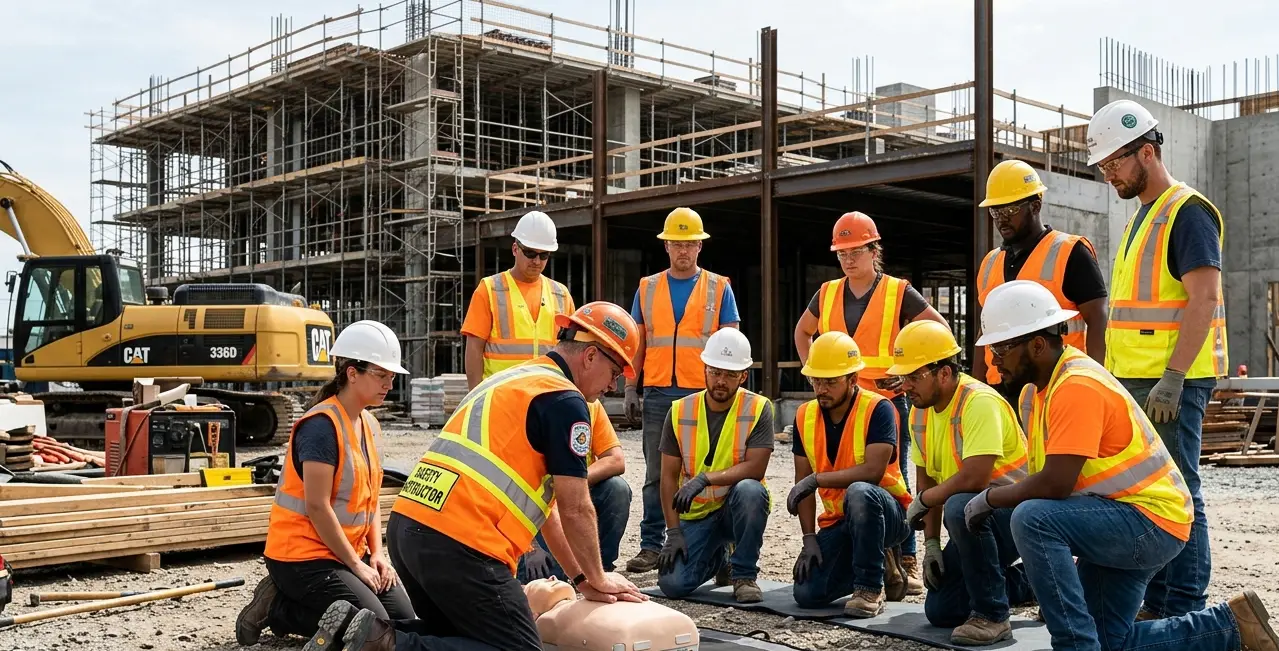
Yes. If you operate a construction company in California, OSHA requires first aid trained personnel on every jobsite where medical facilities are not reasonably accessible. This is not a recommendation. It is a federal regulation under 29 CFR 1926.50, and Cal/OSHA enforces additional requirements on top of it. A-B-CPR in San Diego has certified construction crews across Southern California for more than 25 years, and this article explains exactly what the rules require and how to meet them.
For a broader overview of all OSHA and Cal/OSHA requirements, see our guide to OSHA CPR requirements for California employers.
What OSHA 1926.50 Requires
OSHA’s construction safety standard, 29 CFR 1926.50, is specific. It states:
- The employer shall ensure the availability of medical personnel for advice and consultation on matters of occupational health.
- When a medical facility is not reasonably accessible, a person who has a valid certificate in first aid training shall be available at the worksite.
- First aid supplies shall be easily accessible and appropriate for the construction hazards present.
On most construction jobsites, a hospital or clinic is not within 3 to 4 minutes. That means trained first aid personnel must be physically present during all work hours. No exceptions for small crews or short-duration jobs.
California Adds Additional Requirements
Cal/OSHA goes further than the federal standard in several areas:
Heat illness prevention. California’s Heat Illness Prevention Standard (Title 8, Section 3395) requires employers to train all employees and supervisors on recognizing and responding to heat-related illness. First aid trained personnel play a direct role in this response. On California construction sites during warm months, heat illness is one of the most common emergencies.
Injury and Illness Prevention Program (IIPP). Every California employer must maintain a written IIPP under Title 8, Section 3203. This plan must include procedures for workplace emergencies, including who is trained in first aid and where supplies are located.
High-hazard work. Trenching, scaffolding, demolition, and confined space work all carry additional Cal/OSHA safety requirements that intersect with first aid readiness.
For a complete step-by-step audit of your Cal/OSHA obligations, use our Cal/OSHA compliance checklist.
Remote and Mobile Jobsite Considerations
Construction work rarely happens at a fixed location, and that creates unique compliance challenges:
Multiple jobsites at once. If your company runs crews at different locations, each active site needs its own trained first aid personnel. You cannot rely on one trained person driving between sites.
Rural and remote locations. Jobsites outside urban areas are often far from hospitals. The further you are from emergency medical services, the more critical on-site first aid capability becomes. In remote parts of San Diego County, Riverside County, and the Inland Empire, response times can exceed 15 minutes.
Temporary and short-duration work. Even a one-day job requires first aid coverage if the site is not near a medical facility. OSHA does not waive the requirement based on project duration.
Contractor and subcontractor coordination. On multi-employer jobsites, the general contractor typically bears responsibility for overall site safety, but each employer is responsible for their own employees’ training. Having overlapping trained personnel across contractors is a best practice, not a redundancy.
Best Practices for Construction Safety Training
Meeting the minimum keeps you legal. These practices keep your crews safer and reduce liability:
Train more people than the minimum. OSHA requires at least one trained person per site, but injuries do not wait for the one trained person to be nearby. A-B-CPR recommends having at least two certified people per active crew.
Include AED training. Cardiac arrest can happen on a jobsite, especially during physically demanding work in heat. AED training is included in A-B-CPR’s combination CPR/AED and First Aid class and adds real response capability.
Schedule annual refreshers. CPR cards last two years, but hands-on skills degrade much faster. Annual practice sessions keep response times sharp.
Integrate first aid into your toolbox talks. A 5-minute discussion about first aid response during a weekly safety meeting reinforces training without pulling anyone off the job.
Document everything. Keep copies of all certification cards, training dates, and first aid kit inspections. Cal/OSHA inspectors will ask for these records.
Get Your Construction Crew Certified
A-B-CPR in San Diego provides AHA-certified CPR, First Aid, and BLS training for construction companies across Southern California. Group on-site training means your crew gets certified at your location, on your schedule, with zero travel time.
Host a class at your jobsite or office or view our class schedule. Call A-B-CPR at (619) 281-3304 for a free group training quote.
Frequently Asked Questions
Does OSHA 1926.50 require CPR training on construction sites?
OSHA 1926.50 requires a person with a valid first aid certificate on every construction site where medical facilities are not reasonably accessible. Standard first aid certification courses from the American Heart Association include CPR training as a core component. So while the regulation says “first aid,” the training that satisfies it includes CPR. A-B-CPR in San Diego offers the AHA combination CPR/AED and First Aid class that meets this requirement.
What type of CPR certification do construction workers need?
Construction workers should hold a combination CPR/AED and First Aid certification from a nationally recognized provider like the American Heart Association. BLS for Healthcare Providers is not required for construction personnel unless they also work in a medical capacity. A-B-CPR’s Heartsaver CPR/AED and First Aid course is the standard choice for construction industry compliance.
Do subcontractors need their own CPR trained personnel on a jobsite?
Yes. OSHA holds each employer responsible for the safety of their own employees. On a multi-employer construction site, the general contractor manages overall site safety, but individual subcontractors must ensure their workers have access to trained first aid personnel. Relying solely on another contractor’s trained employee does not satisfy the requirement.
How do remote construction sites handle first aid requirements?
Remote jobsites that are far from hospitals or clinics have an even greater obligation to have trained personnel on-site. A-B-CPR recommends training multiple crew members for remote projects, carrying enhanced first aid kits with additional trauma supplies, and establishing a clear emergency transport plan before work begins. In rural parts of Southern California where ambulance response times exceed 10 minutes, on-site first aid capability is the first line of response.