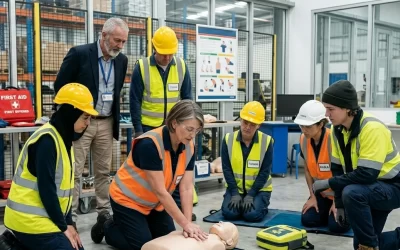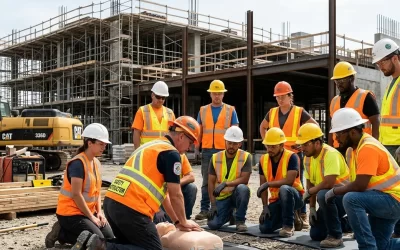
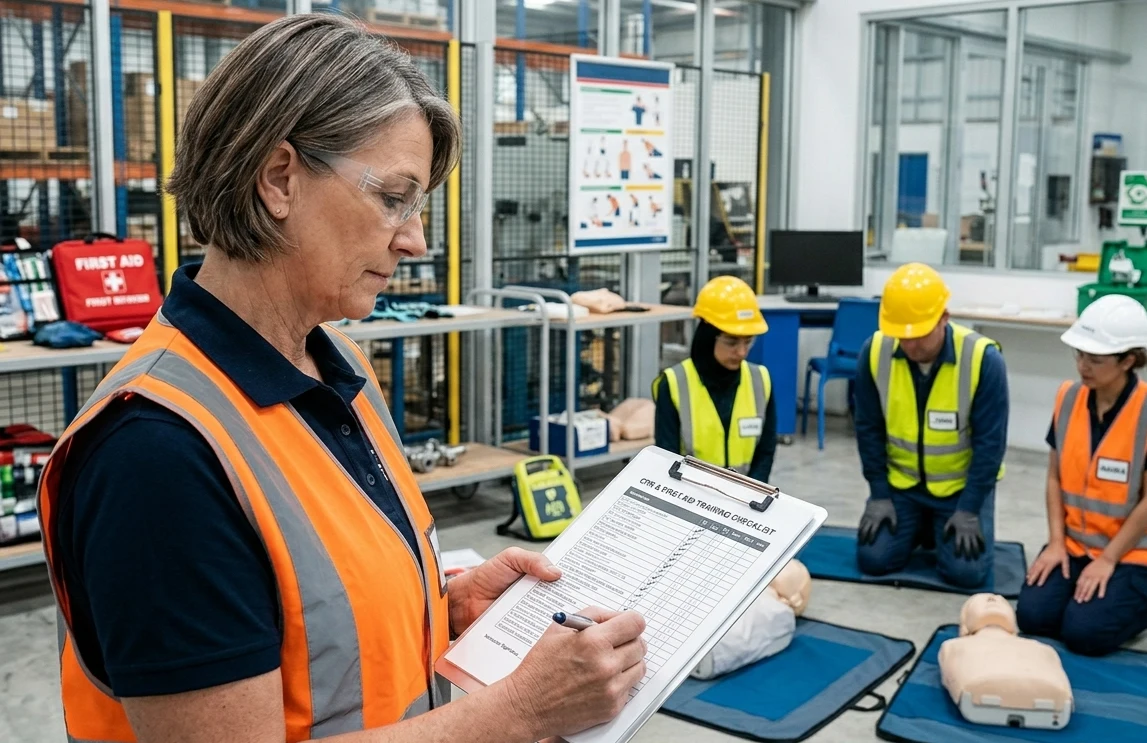
California employers must meet Cal/OSHA’s first aid and CPR standards under Title 8 of the California Code of Regulations. This is not optional, and the requirements go beyond what federal OSHA mandates. If you have employees in California, this checklist covers exactly what you need to have in place. A-B-CPR in San Diego has worked with businesses across Southern California to help them meet every item on this list.
For a broader overview of federal and state regulations, read our guide to OSHA CPR requirements for California employers.
The Cal/OSHA First Aid and CPR Compliance Checklist
Use this checklist as a practical audit tool. Go through each section and verify your workplace meets the standard.
1. Trained Personnel on Every Shift
Cal/OSHA requires that trained first aid personnel be available during all working hours when emergency medical services are not within close proximity (3 to 4 minutes response time). This means:
- At least one employee per shift holds a current CPR and first aid certification.
- Multi-location businesses need trained staff at each site, not just the main office.
- Coverage does not lapse during vacations, sick days, or schedule changes. Train enough people to maintain a buffer.
How many people is enough? There is no fixed ratio, but most compliant businesses train at least two per shift or location. A-B-CPR in San Diego recommends training 10 to 15 percent of your workforce to maintain reliable shift coverage.
2. Accepted Certification Courses
Cal/OSHA accepts CPR and first aid certifications from nationally recognized organizations including the American Heart Association (AHA), American Red Cross, and National Safety Council. For childcare, EMSA-approved courses are specifically required.
All A-B-CPR courses are AHA-certified and EMSA-approved, meeting both Cal/OSHA and industry licensing requirements. View available courses.
Key points:
- Certification cards must be current (AHA cards are valid for 2 years).
- The course must include a hands-on skills component. Online-only courses generally do not satisfy Cal/OSHA for high-risk workplaces.
- BLS for Healthcare Providers is required for clinical and medical staff.
3. First Aid Kit Requirements
Title 8, Section 3400 requires employers to maintain adequate first aid supplies. Your first aid kits must be:
- Stocked and accessible. Placed in locations employees can reach quickly, not locked in a closet.
- Appropriate for your workplace hazards. An office needs different supplies than a construction site or a restaurant kitchen.
- Inspected regularly. Check kits monthly. Replace used or expired items immediately.
At minimum, kits should include adhesive bandages, sterile gauze pads, adhesive tape, scissors, elastic wraps, antiseptic wipes, CPR breathing barriers, and disposable gloves. High-hazard environments require additional items like eye wash stations, burn dressings, and tourniquets.
4. AED Placement and Readiness
While Cal/OSHA does not mandate AEDs for all workplaces, many California cities and counties require them in buildings above a certain occupancy or square footage. Even where not legally required, Cal/OSHA considers AEDs a best practice, and having one can significantly reduce liability.
If you have an AED, make sure it is:
- Accessible within 3 minutes from any point in the building.
- Inspected monthly for battery and pad expiration.
- Registered with your local EMS agency (required in many California jurisdictions).
A-B-CPR provides AED equipment and training for businesses across Southern California.
5. Documentation and Record Keeping
Cal/OSHA inspectors review training records during audits. Keep documentation organized and current:
- Training completion records for every certified employee, including course name, provider, date completed, and expiration date.
- Copies of certification cards (front and back).
- First aid kit inspection logs with dates and inspector initials.
- AED maintenance records if applicable.
- Incident reports for any workplace injuries where first aid was administered.
Store these records digitally and in a physical binder at each location. Retention period should be at least five years, or the duration of employment plus three years.
6. Emergency Action Plan
Cal/OSHA requires a written Emergency Action Plan under Title 8, Section 3220. This plan must include:
- Designated first aid responders and their locations.
- Emergency contact numbers (including 911, poison control, and your nearest hospital).
- Evacuation procedures.
- Location of first aid kits and AEDs.
- Procedures for reporting workplace injuries.
Review and update the plan annually, and any time your staffing, layout, or hazard profile changes.
7. Employer Best Practices Beyond Minimum Compliance
Meeting the minimum gets you past an inspection. These practices keep your people safer:
- Recertification reminders. Set calendar alerts 90 days before each employee’s card expires. A-B-CPR offers recertification classes on a flexible schedule at both San Diego locations.
- Annual refresher drills. Even with current cards, a quick hands-on practice session keeps skills sharp.
- Buddy system. Pair trained employees so there is always backup.
- Post-incident review. After any first aid event, review what happened and whether your protocols worked.
Ready to get your team certified? A-B-CPR in San Diego offers on-site group training so your staff can get certified without leaving the workplace. Call (619) 281-3304 for a free quote.
Frequently Asked Questions
What does Cal/OSHA require in a workplace first aid kit?
Cal/OSHA requires first aid supplies that are appropriate for the workplace hazards present. At minimum, kits should include adhesive bandages, sterile gauze, tape, scissors, elastic wraps, antiseptic, CPR barriers, and gloves. Construction sites, kitchens, and manufacturing facilities need additional items based on the types of injuries most likely to occur. A-B-CPR in San Diego can advise businesses on kit requirements during group training sessions.
Can online-only CPR courses satisfy Cal/OSHA requirements?
In most cases, no. Cal/OSHA expects first aid and CPR training to include hands-on skills practice and evaluation. Blended courses that combine online learning with an in-person skills session are accepted. Fully online courses without a hands-on component generally do not meet compliance standards for high-risk workplaces. A-B-CPR offers in-person, hybrid, and on-site training options that all satisfy Cal/OSHA.
What happens if my business fails a Cal/OSHA first aid inspection?
Cal/OSHA can issue citations and fines. Serious violations (where there is a realistic possibility of death or serious harm) can carry penalties of up to $25,000 per violation. Repeat or willful violations can result in significantly higher fines. Beyond the financial penalty, a failed inspection can trigger follow-up audits and increased scrutiny.
Do I need a written first aid policy to comply with Cal/OSHA?
Cal/OSHA requires a written Emergency Action Plan (Title 8, Section 3220) that includes first aid response procedures. While a separate written first aid policy is not explicitly mandated, it is a best practice that documents your training schedule, designated responders, kit locations, and incident reporting procedures. During an audit, having a clear written policy demonstrates that first aid compliance is part of your operating procedures, not an afterthought.